
Ready to learn about local ecology!
What's this?
River's Park Edge and its partners are pleased to offer all visitors a fun, educational challenge to locate ecological clues thoughout the park.
Learn more
Loess soil
In Western Iowa, we live among the Loess Hills. Did you know the hills get their name from the soil in the area?
Loess is a type of soil: It is a fine sediment comprised of silt particles formed beneath glaciers. It’s powdery and soft but strong when packed. The word “loess” is German for “loose” and it’s pronounced “luss,” rhyming with “bus.”
Scroll to learn more
Prev NextWhat else can I find?
River's Park Edge is home to many points of interest. But if you found this information interesting, keep seeking out more clues.
Seek for more ecology clues
The Loess Hills of Western Iowa were formed between 12,000 and 150,000 years ago when glaciers advanced and retreated, leaving behind the silt from finely ground rocks.
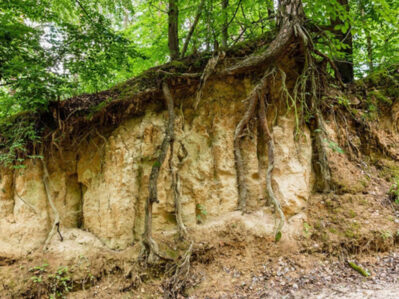
The predominantly westerly winds blew the loess silt into giant piles between 64 and 200 feet deep, creating the Loess Hills landform.
Although loess soil appears in many places around the world, the Loess Hills are geologically significant landforms because of the depth and extent of the soil, covering more than 1,000 square miles.
Learn more about our area’s loess soil from the U.S. Geological Survey.